High Performance Health Podcasts -579
The High Estrogen, High Histamine "Perfect Storm" No One Warns Women About
The conversation explores the link between estrogen loss and a leaky small intestine, the histamine-hormone "perfect storm" that can trigger hives and cramping, and why bloating during perimenopause is so often multifactorial. Cynthia also explains when bloating becomes a red flag worth investigating.
AUDIO
TRANSCRIPT
[Angela Foster] (0:00 - 0:09)
When we look at the health of our mitochondria, these are the powerhouses of our cells. What types of exercise can improve the quality and function of our mitochondria?
[Brad Currier] (0:09 - 0:25)
Endurance exercise like running, cycling, swimming, as well as interval training have tremendous benefit. But what's been appreciated more and more in recent years in the research community is the benefits of it. It is extremely important for everyone to resistance train, but especially women.
[Angela Foster] (0:25 - 0:30)
Will exercise on its own stimulate mitophagy? Will that help clear out old mitochondria?
[Brad Currier] (0:31 - 0:32)
Super question, and yes, it does.
[Angela Foster] (0:32 - 0:38)
For someone listening to this, how should they start to think about that if they really want to take care of their mitochondria?
[Brad Currier] (0:38 - 0:45)
What I would say on this and how do we benefit from those specific types best for our mitochondria is...
[Angela Foster] (0:45 - 1:22)
Brad, it's so good to have you here today. I just am very excited to dive into all the latest science on mitochondrial health, on muscle and strength and endurance and just performance. For everyone that loves fitness or just wants to have more energy as they age, I just think exercise is probably the sharpest tool we have.
It's just fantastic. I know you're deep on the research here. You oversee all the clinical research at Timeline.
You also were involved in the ACSM new guidelines as part of your PhD on resistance training, which I want to dive into because those were quite exciting. So firstly, welcome.
[Brad Currier] (1:23 - 1:47)
Well, Angela, thank you so much for having me. I'm really excited to be here and talk all things mitochondria, performing at a high level exercise. And right off the bat, I couldn't agree with you more.
Exercise is probably the most valuable tool we have in many ways to help not just perform better, but age healthily. It's really an indispensable tool. So thanks so much for having me and I'm excited to get into it.
[Angela Foster] (1:48 - 2:14)
We'll see where it takes us. So first of all, I think let's set the scene for anyone that doesn't know what mitochondria are. So mitochondria are the battery packs of our cells.
They are really what give us our energy and they're linked to so many or the decline is linked to so many what we're learning is chronic diseases and ageing. But yeah, please, you are the PhD here. Please give us kind of a really good understanding of why our mitochondria are so important and how they affect exercise capabilities.
[Brad Currier] (2:15 - 3:28)
Absolutely. And you're completely right where the mitochondria, you know, ask a high school biology student, what's the mitochondria? That's the powerhouse of the cell.
And, you know, it is that battery pack where the energy needed for all of our cells to function, whether it be a muscle, a heart, a brain cell, an immune cell, all of these things are predominantly powered by our mitochondria. But the mitochondria is also a lot more than just an energy factory. It's involved in so many other things that happen at the cellular level.
And you really do see that manifest when we look at the development of diseases, like you mentioned, where there's a great researcher out of Yale who has this really nice line of work showing that when a mitochondria dysfunctions, it actually ends up impacting our ability to like our insulin sensitivity and the prevalence of things like cardiovascular disease, type two diabetes. These can all in many ways be traced back to mitochondria dysfunction. So the mitochondria are critical, yes, for, of course, performing well and operating in a healthy way.
But they're also things to take care of, because when they start going off the rails, there's a lot of negative consequences.
[Angela Foster] (3:29 - 4:09)
Yeah, so we need to take care of them. You were involved in the research that we just mentioned there, these new ACSM guidelines. I think the thing that really struck me was that I think so many women have been confused recently over recent years thinking, should I be syncing with my cycle in terms of my training?
What do I do in perimenopause? Do I need to lift heavy? But what if I'm new to exercise, there's a high risk of injury, you know, do I need to get close to failure or absolute failure?
And these guidelines seem to you and I talking offline that they're, they're not as sexy as they might be, but they definitely have made it more straightforward. You involved in that research, what are the key things that someone listening to this can take away from those guidelines?
[Brad Currier] (4:10 - 6:24)
You're absolutely right. And I'm glad we get to talk about resistance training, which exercise as a whole is fantastic, but weightlifting itself, or I shouldn't say weightlifting, but just resistance training is so powerful. The take home from these is that anything is better than nothing.
And I would set the scene with a couple of things. One, the vast majority of people, most countries, over 70% of people do not meet the recommendation of twice weekly resistance training. If you go down to people who are doing nothing, that's still more than half of the population.
60% of the people do no resistance training. So most people aren't doing this. And what we did is we took all the data that's been published on resistance training and brought it together to try to figure out what is that best programme.
And as you said, the take home message is not sexy, but over 30,000 people worth of data, we found that pretty well, every programme works, whether it's lifting with the traditional kind of barbells or even things like elastic bands or training at home, just going from doing nothing, which most of us are to doing something was incredibly beneficial for our strength, our muscle health, and even functional performance. So things like being able to get up out of a chair, how well we can walk, which are really important as we age, not just through our whole life.
So the take home I would give to everyone is that if we're not performing any resistance training, we need to find the thing that's going to be best suited for our schedule, because just doing anything regularly is more powerful than doing nothing. And on your point about females, I completely agree that it's been a very noisy place and a lot of social media has not helped that. And I think what we're hoping to do with this paper is really have that power, empowering effect with practitioners and individuals looking to participate in resistance training that it doesn't need to be that dungy, heavy, iron filled gym.
You know, there's a lot of ways that we can practise resistance training that will suit our preferences, and it will be beneficial. So it is extremely important for everyone to resistance train, but especially women.
[Angela Foster] (6:25 - 7:26)
Yeah, I think, you know, that's just so reassuring for many women, because the women that I work with, they actually really enjoy getting a sweat on and working out. Many women love resistance training. I love it.
But I also know that sometimes just lifting at moderate to high reps just feels more fun. You're getting more of a burn. You're getting a little bit of that cardiovascular stimulation at the same time.
And you've come out of the gym on a bit of a high, you feel like you've had a workout. And I think the resistance that I feel, don't get me wrong, I still do these because I still like to build strength is on the compound moves, you know, where you're lifting like three to five reps, and then you're sitting around for two to three minutes, it kind of like kills a lot of the joy. You have to be really committed and it has its place.
But I think to know that if you prefer training in the eight to 10 rep range, great, you're still going to get results. The key thing, my understanding is we just need to get close to failure, but the number of reps itself matter less.
[Brad Currier] (7:26 - 9:23)
Yes, and I'm with you six to eight reps. That's my personal favourite range. I love that kind of mid range rep.
And I think a key distinction for people is there's a difference between good for health and optimising performance. For the vast majority of us mere mortals, we can focus on what's going to be good for our health and benefit for years and years. And that would be something like the six to eight or six to eight to 10 rep ranges we're talking about.
For most people, if they do that, they're going to get stronger. You know, if you're progressively adding a little bit of weight as you improve your strength, we will build strength with that. Now, if we shift to the point one percenters who are the Olympians, the elite athletes, you know, and they need to maximise their strength.
That's where we're going to be looking at the single rep, true strength building optimisation to get every single bit of strength we can out of that individual. But for most of us, if we're just looking to get stronger, we can do that in that rep range that suits our preferences. And it's so important because that's what keeps people coming back, whether it's ourselves or someone we're working with, you know, more than about 50 or it's 51 percent of people drop out of an exercise programme in the first two months.
And that's a lot of times because they don't like it. They don't have time. That's the common, I guess, reason given.
But if we make this fun or at least something that we enjoy doing, that adherence is what we really need to focus on early in a programme so that they keep coming back and we'll be able to accomplish all these benefits with a wide range of programmes. So that was something with this position stand that we really tried to look at is not just what's good for optimal performance, but what's going to help and be beneficial for the 99 percent of us other folks.
[Angela Foster] (9:24 - 9:49)
Yeah, exactly. So for the woman listening to this who is thinking, well, I want to enjoy working out. I want to get the longevity benefits, the health span benefits.
But I'm also paying attention to the way that I look. We've got summer coming up now and you want to have a little bit of definition. Is there an ideal rep range to achieve that in order to get those aesthetics alongside the health span benefits?
[Brad Currier] (9:50 - 11:13)
Yeah, it's a great question. And one, I would just preface this like so much in this space can be is that every individual is going to be different. And that's actually one of the key principles we highlight for any programme.
You know, it needs to be specific to someone's goals. It needs to be tailored to that individual. I would say that's the most important thing.
And progressive overload, which is just making sure that as we get better, we are making that stimulus a little bit harder so we keep improving. On the aesthetic side, there's a lot that goes into that other than just our muscle tone, right? We all carry a little body fat, which is good for us in the right amount, but in different places and how we accomplish that aesthetic is not going to be most impacted by just a programme.
You know, if we are in a place where we're looking to maybe lose a little bit of weight, then we're going to, I would first advise people to look at the diet. You know, there's a great phrase that weight is lost in the kitchen, muscles built in the gym. And in tandem, along with sleeping well, managing our stress levels, these are all things that can impact our aesthetic.
And if we're going to look at, try to improve that a little bit, as long as we're engaging in some form of exercise regularly, I don't think that's the first place to start looking at to do just that.
[Angela Foster] (11:13 - 11:31)
Yeah, that makes a lot of sense. I think the nutrition and the stress management and the sleep, as you say, make a massive difference to the aesthetics. When we look at the health of our mitochondria, as we've said, right, these are the powerhouses of ourselves.
Specifically, what types of exercise can improve the quality and function of our mitochondria?
[Brad Currier] (11:32 - 12:42)
Yeah, and maybe just for those who, you know, have an exercise physiology background, it's kind of thought the endurance exercise, that's the way that we improve our mitochondria. And that's true. Endurance exercise, like running, cycling, swimming, any of those long form activities, as well as interval training, have tremendous benefits for our mitochondria.
But what's been appreciated more and more in recent years in the research community is the benefits of things like weightlifting for our mitochondria. So when you look at individuals who weight train versus not, their mitochondria are better. And when we look at how someone's mitochondria health changes throughout a programme, it does get better.
The mitochondria are more efficient. They are working better. So all exercise can improve the mitochondria.
Certainly, that endurance type exercise, the aerobic activities, where we're really dependent on the mitochondria, as we get more and more trained, those are the aerobic activities are where we'll see the biggest and continued improvements in mitochondria health.
[Angela Foster] (12:43 - 13:38)
So for an untrained individual, is what you're saying is they're going to get benefits, whatever exercise they start doing, whether that's resistance training or aerobic. But then once we get to a kind of certain standard, if you like, maybe we've been training a year or more, then actually, if we want to further develop our mitochondria health, just like someone like me, I get called out. I love work because it calls me out.
The thing that I love going on walks, I just think it's really nice. I love walking with my dogs, but then I like to be chilled and I don't want to be specifically in zone two. Do you know what I mean?
I just want to enjoy it. And then I love weightlifting and I love a good sprint. And so then Woot holds me accountable because it's like, where's your time in zone two and a little bit of zone three?
And it calls on me to do it. But it's what you're saying then. So for somebody who's physically active, they've been have a pretty good training history, they're going to need to start building that endurance in order to see further improvements through exercise on their mitochondria.
[Brad Currier] (13:38 - 14:42)
Yeah, you're right on the money. And this was something that was actually really deeply studied by a collaboration between my former institution, McMaster in Canada, and a group out in the UK, there where you're based. Connor Steed and Aaron Thomas are the lead authors on this, but what they did is look at untrained people and take them through a programme.
And you really see that there is just everything getting better. Mitochondria are improving with resistance training. Resistance training is improving all these parts of our cell as is endurance.
But as someone gets more and more trained, our cellular machinery is refined. And you start to see that differentiation between those doing aerobic activities and those doing weightlifting activities. So you're exactly right.
If someone's not training in any form, they're going to benefit from any type of exercise. As we get well, more, better and better trained, and we're talking, you know, several months, years into training, that's where you'll start to see a refined benefit from particular types of training.
[Angela Foster] (14:43 - 15:39)
If you're getting value from this show, the single best thing you can do to help us keep bringing you the highest calibre guests is to subscribe or follow wherever you listen or watch. It takes 10 seconds, but it genuinely makes a difference to the quality of the guests we bring you week after week. So let's talk about that because I think it's really interesting.
So for someone listening to this who is exercising regularly, right, they're doing some resistance work to maybe two to four times a week, depending on how much they enjoy it. Then they're looking at their aerobic or even let's just talk about cardiorespiratory because it can be aerobic and anaerobic, their HIIT training. How should they start to think about that if they really want to take care of their mitochondria?
Like what would be an ideal if we use me as an example, like what would be an ideal amount of time that I should spend in zone one and two at the top end and kind of four or five and then that sort of middle zone three into four? Like how should I structure that week?
[Brad Currier] (15:39 - 17:49)
Yeah, and it's a great question and funny how you kind of lay out your training. It's actually very similar to mine as well, where, you know, like my weightlifting a few times a week, I love my interval training and then hiking. And it's especially with nice weather coming here in summer, the long runs, those days are behind me more so.
So really leaning on the time benefits of interval training for those mitochondria benefits. What I would say on this and how do we benefit from those specific types best for our mitochondria is kind of a mix of that aerobically challenging bit. And there's some really nice work done by many groups, but on the interval training and looking at how mitochondrial adaptations compare in the interval training to the aerobic training.
And a lot of times they actually end up being quite similar. We see an increase in mitochondrial volume, mitochondrial efficiency can improve as well. And with both cases, the biggest difference ends up being the amount of time someone spends.
So in these cases, we can trade intensity for volume and still have similar benefits. And because of that, I would say it's very good to just do whatever you find most enjoyable or would do regularly. The caveat I would add is if you're training for a particular event, there's this principle of specificity in exercise prescription.
And that's that our adaptations are going to be specific to our training stimulus. So really what it means is we need to practise what we want to get good at. If we want to run a marathon, we need to run those long distance.
There's an element of we've got to do the miles. Similarly, if we want to get really good at a particular lift, like a clean and jerk, we need to practise that movement because we'll really refine the machinery needed to optimise that particular activity. But for just mitochondrial health, like I said, for the vast majority of us, we see very similar adaptations between the short kind of, you know, one minute intervals, 30 second intervals done a few times to the 45 minute runs at a moderate intensity.
[Angela Foster] (17:50 - 18:28)
Interesting. I'd been reading previously around the fact that when you look at mitochondrial biogenesis, right, the creation of new mitochondria, this idea that in order for that to take place, you need to kind of do a very short, sharp sprint. So like sprint interval training as opposed to HIIT, where you are simulating that natural experience of running from a predator.
And now you get this upgrade, right? You can't run for very long at that speed. So is that a necessary part?
Should people be doing sprint interval training where it's kind of like four to, I think, 20 seconds, and then you take a long recovery and come back again?
[Brad Currier] (18:29 - 19:44)
Yeah. And I'll show you Jenna Gillen, who's a wonderful researcher. She's a professor at University of Toronto now that did some of this first sprint interval training.
But in that, I think what's important to think is almost at a foundational level, what is the signal that causes mitochondrial biogenesis? And there are a few signals in our cell that do this. And really, you can think of our muscle is something our cells want to adapt to challenges that they face.
You know, this is that homeostasis that we try to accomplish as living organisms. And when we challenge our body, such as by, we're running out of oxygen, or we've got a lot of activity going on in the cell, our body wants to adapt so that we can better handle this stressor. And in both cases of the sprint interval training and the long form distance, we can get to that place where we have the triggers.
It happens a lot much quicker with the sprint interval training because it's a more intense stimulus. But over time, as long as we are working at that sufficient, this stimulus is sufficient, we'll be able to accomplish that improvement in mitochondrial health.
[Angela Foster] (19:45 - 19:49)
Okay, so we can actually do, we can do short sprints, and we can do longer ones as well.
[Brad Currier] (19:49 - 20:16)
Yeah, both will, you know, if you go for a 45 minute run, and you're not tired afterwards, probably didn't do quite enough. You know, you should be out of breath a little bit. And it's actually a way you can look at how hard someone's working, literally just your breathing rate, if you're elevating your heart rate, your breath rate, that means you're you're putting a demand on your body to do a certain amount of work.
And we can certainly get to that point with both forms.
[Angela Foster] (20:17 - 20:42)
Both forms. And what about so when you're looking at like the lower intensity, or a lot of people have heard about zone two, they may or may not be measuring it with a heart rate, but they're thinking about the talk test, right, where they can, they can say a few words, have a bit of a conversation, they might be out running with a friend, they just can't hold a full conversation. In that sort of type of exercise, are we improving the efficiency of our mitochondria?
Are we also helping create new ones?
[Brad Currier] (20:42 - 21:30)
Yeah, it kind of goes in tandem. So both, within all the mitochondria, you know, there's millions and millions of mitochondria throughout our body. And we both will have that happening where we're creating the signal to make new mitochondria, but we'll be also sending a signal to make the mitochondria we have more efficient.
And that really just depends on the state the mitochondria is in. So if it's, if we think it's working out like 90%, then we might be able to just make it a little bit better. We'll also send the signal to make more to help it achieve this load.
But these are, I would say this is something that is very specific and tough to parse out with a high degree of confidence in human randomised trials.
[Angela Foster] (21:31 - 22:22)
So what we do know is that fundamentally, we want to enjoy it because we're going to go back and do it again. And we will exercise as opposed to not exercise. And within that, if you're kind of exercising a few times a week, right, and do a combination of the resistance work with some of this aerobic and also some high intensity, right, just mixing it up, having fun, maybe even playing a game of paddle tennis where you're running for the ball, right, just make it super fun, some swimming, some biking, anything, hiking, you mentioned, actually, we're going to be looking after them pretty well. I know there's another bit that, which is the mitophagy, right, which is clearing out old dysfunctional mitochondria.
You have some very interesting studies that I want to dive into in a moment. Will exercise on its own stimulate mitophagy? So will they help clear out old, will that help clear out old mitochondria?
[Brad Currier] (22:22 - 23:49)
Super question. And yes, it does. If we think about exercise, what it's doing is causing turnover, it's causing renewal in our body.
And if we think of that cycle of renewal, there's a removal of the bad and the addition of the good. And that cycle is really what exercise does. We are putting a stimulus on our body and it's going to go through that adaptation, that renewal, to improve our physiology.
And on the mitophagy bit, you're, you know, you're absolutely right. We can think of the mitochondria in three phases. Mitochondrial biogenesis, the creation of new mitochondria.
When we have a mitochondria, we can make it more efficient. It goes through processes called fission and fusion, where we actually have a network of mitochondria within our cell. They're not just a little jelly bean.
They work together to become more efficient. And then the last bit is mitophagy, which like anything in our body, when it's the selective removal of dysfunctional mitochondria. And that's really a key part in recovery and ageing, because that's where when we have an accumulation of dysfunctional mitochondria, we talked about how bad mitochondria have so many negative effects on our health and performance.
That's where it originates. So it's kind of like thinking about your house. If we have a super cluttered house, there's only so much we can do to improve it.
At one point, we've got to take out the garbage, you know?
[Angela Foster] (23:50 - 24:28)
Yeah, exactly. So we need all of those things. Right.
Interesting. So then when we're looking at mitophagy and clearing out old dysfunctional mitochondria, you've done some really interesting research looking at both untrained individuals, right, but also fit individuals, athletes, and then looking at what happens when you give them urolithin A. One of the studies you mentioned was a study of soccer players where you're looking at vertical jump, which is like a measure of power, right?
So that's actually showing us in real time how the mitochondria are working. What happened there?
[Brad Currier] (24:28 - 25:48)
Yeah, so and it's a really a testament to the whole R&D team at Timeline. It's been really taken 20 years to do the highest level of research on mitochondrial urolithin A. And this particular study in soccer was led by an independent investigator named Professor Mitch Naughton down in Australia.
And these were really high level academy soccer players that they had coming in for a preseason training camp. So six weeks of super intense training, gearing up for the season. And in this study, they had the athletes consume either one gramme of MitoPure or a placebo.
And it was kind of their post training shake that they added this powder to. And what we saw after the six weeks is, yeah, vertical jump improved significantly in the MitoPure group compared to the placebo. It was a 3.2 centimetres, if I remember, but a notable amount. For reference, that's like the difference between winning the NBA combine and finishing outside the top 50. If I remember this year's data correct, but it's a major improvement in vertical jump, which is a great measure of muscle power, right? Because we're not just generating force, we're generating force quickly.
And that was a really cool finding from Mitch's work.
[Angela Foster] (25:49 - 26:08)
Yeah, that's really interesting. There was another one that you and I were talking about offline, which was a study in weightlifters. And I do want to say, actually, because most of your studies are in women, we're always hearing about how there's not enough research in women, but you include women in your research.
What happened with the weightlifters?
[Brad Currier] (26:09 - 27:52)
Yeah, it is something we're very proud of where we actually just kicked off a new study this week. So I'll get the recruitment numbers, but we do see about two thirds of participants in our studies overall are women. So it is definitely something that's very important, right?
We're trying to find things that are most effective for the entire population. And this weightlifter study actually, again, was a clinical trial done independent of timeline. We had no idea the study was happening.
It was just published one day. I didn't realise they basically bought the product and did the study. It was one of the top sports science institutes in China that did this study.
And what they did is take some really well-trained weightlifters. So these are people who had been weightlifting, had proven training records for over two years. They could lift, squat more than two times their body weight, just really representative of a well-trained group.
And this was an eight-week study where similarly, they randomised people to a placebo or a MitoPure group. The MitoPure group took one gramme per day. And after this training intervention, we saw that, yes, muscle strength improved in the excuse me, in the MitoPure group, and also performed a test called repetitions to fatigue.
So that was one where people are lifting a sub-maximal weight, like 70% of their maximum lift, and seeing how many repetitions they can do. And in both cases, that knee extension strength and the reps to fatigue significantly improved in the MitoPure group compared to placebo. That was a really cool study to see.
And like I said, unbeknownst to any of us that it was even happening, and then it was there.
[Angela Foster] (27:53 - 28:09)
That's so cool. I definitely noticed since taking it myself, I'm definitely stronger on my lifts, but I would say I feel like I recover faster. Like I've got a lot of volume now in my week.
Is that something you've observed that people will recover quicker?
[Brad Currier] (28:09 - 30:02)
It's funny you say that because anecdotally, that's personally also what I've noticed since starting MitoPure. And it is actually something that was looked at briefly in another performance study. It was done in collaboration with Dr. Louise Burke. I know we were talking offline. Louise is Mount Rushmore of great sports, physiology, nutrition researchers. Based out in Australia, I would highly recommend her work to anyone looking at performance nutrition.
Simply one of the best. But this was a collaboration that our group had with Professor Brooke Burke. And in this case, they had really elite runners.
So these were people who they're not just doing a marathon. These are people kind of going for the Olympics. And it was leading into the second to last Olympic cycle that they had this training camp.
And what these individuals did is they came to camp. It was a four-week intervention where they were randomised to MitoPure placebo. And before and after the intervention, the participants did a time trial.
And this was a five-kilometre time trial. And what they saw is that after the one month of supplementation, rate of perceived exertion and a marker called creatine kinase, which is representative of muscle damage, were significantly lower in the group taking MitoPure. So this is, I would just transparently say, this is scratching the surface, but it's certainly given the indication that there might be a benefit to recovery here and something that we would love to explore more in future studies.
But we see less markers of muscle damage and that the athletes taking MitoPure actually felt they didn't have to work as hard to accomplish the same performance. So that was a really intriguing finding.
[Angela Foster] (30:03 - 31:31)
I think it's really intriguing and just really relevant, actually, for women like myself who are listening to this who are in that perimenopause bracket where recovery often starts to feel like it's taking longer. Inflammation is higher. You get more aches and pains.
And actually, it can be a really frustrating time because you can feel more injury-prone, for example. And I think that I'm super grateful that I can train as often as I do and just really enjoy it and then have all of the benefits from energy. I always like to test stuff.
So I then took a break deliberately because I think it's really interesting, isn't it? If you're taking something, I'm a big believer as well about being intuitive with it and going, OK, well, actually, do I feel good on this? I remember speaking with Dr. Will Bee. We were talking about probiotics. And I was like, how do you know, Dr. Bee? How do we know if we've got a good probiotic?
And he was like, do you know what? It's almost as simple as, are you feeling better on the probiotic? Because if you're not, it's probably not the right one for you.
And you might as well not spend money after 30 days. And so I did this sort of experiment where I stopped taking a timeline for a little bit to see. And I noticed after a few weeks, a dip in my energy.
And then since I've gone back on it and I just feel like the energy again, it just takes me to that higher level that I want to operate at because it's the level that life is just more. Do you know what I mean? I feel like I can do everything and have fun with my kids.
[Brad Currier] (31:32 - 33:10)
Yeah, no, absolutely. I mean, that's the reason we're doing all this, right? It's our life.
We want to live it healthfully, fully. That quality of life is what we're after. And it's funny you mentioned that because I'm really lucky.
I get to go to a lot of conferences through the year and speak and meet people who are using the products. And that is probably the most common piece of feedback I get for people is that we say, I stopped it for a little bit. And that's when I noticed the difference.
Because when we're talking about MitoPure, it's the only clinically validated supplement that hits that mitophagy. It's the only thing we know outside of exercise and fasting that hit that mitochondria specific autophagy. So with that, you don't feel it immediately when you are really targeting things at the cellular level, right?
Rome wasn't built in a day. And this isn't a stimulant like caffeine. So what we see in the clinical studies is that it's after one month that we see the improved mitochondrial health in the muscle biopsy samples.
And these performance benefits are after two and four months of taking the product. So it takes time to actually renew and improve this cellular health to ultimately have these functional benefits. And that's funny enough when people do say is like, I wasn't really feeling it the first, you know, three months in, but I stopped it and I felt it and I got back on it immediately.
So it's interesting to hear that you mentioned it. I agree, you know, take one out, it's a way to find what's working or what's causing problems in our diet.
[Angela Foster] (33:11 - 34:01)
100% I think, you know, because you want to know, right, that what you're taking is, is working for you. And obviously, you have all the clinical research to back that up. So I think the science is super important.
But the end, yeah, just seeing how you feel. What was interesting to me, though, is that when I took a break from it, so as you say, the first time you take it, and this is going back at least 18 months, I think, for me, maybe longer, you don't immediately notice it, right, kind of like, gradually, you might see that energy improve. And you're saying it takes at least a month up to four months.
But then when I took a break from it, and I noticed the difference in energy when I got back on it. I'm curious to see if this holds. This is what we always have to discount any kind of placebo is for me, the energy benefits came back quicker.
Almost like I'd, I don't know, I'd built some level, I didn't have to wait.
[Brad Currier] (34:01 - 34:01)
Yeah.
[Angela Foster] (34:02 - 34:04)
Once four months again, they came back after a few.
[Brad Currier] (34:04 - 34:08)
Okay, fascinating. I'm curious. So like, how long was the break that you took?
[Angela Foster] (34:09 - 34:16)
It was around six weeks. Yeah. And it took a bit of time to notice it.
Because I think I was probably it's a bit like riding the wave.
[Speaker 3] (34:16 - 34:16)
Yeah.
[Angela Foster] (34:17 - 34:27)
No, some results from it that I was like, maintaining, and then my energy dropped. And then yeah, within a few weeks, I was back. And I just I really like it.
I also know.
[Speaker 3] (34:28 - 34:36)
I know when I've got good stuff, because my husband starts. And he's always nicking the mitopia.
[Brad Currier] (34:37 - 34:54)
Yes. You're right. It's not immediate.
And, you know, you've given an idea for a great study. So I'll, I'll see what we can do. And maybe we'll actually put some clinical data behind this, because I share your your hypothesis and your experience of what it'd be good to know, right?
It'd be great. It'd be fascinating.
[Angela Foster] (34:55 - 35:18)
Yeah, be really interesting. The other thing, and I did when Jen came on, I was speaking briefly with her about this, but mitochondria are in our skin. So you you guys noticed this to kind of happen by accident that people were taking my understanding is people were taking timeline.
And then they started getting compliments of the fact that they were looking younger. Is that right? And that's how the skin care came about.
[Brad Currier] (35:18 - 37:33)
It came about quite organically. And one of the main reasons for it was exactly that we had. It was kind of just anecdotal feedback from customers and from people that were in the trials where we're looking at muscle health.
So, you know, I've been taking the product a couple months, feel more energetic. I'm getting stronger. My skin looks better.
We thought, well, that's interesting. And being the room of PhDs that we are, we said, all right, well, let's put this to the test. So we formulated MitoPure into a topical cream, and we actually just kicked off our 15th clinical trial on skin and all the products that we now sell.
So maybe I'm letting the cat out of the bag, but it had amazing benefits on skin health. And it makes sense when you think about the skin's our largest organ. It's got lots of mitochondria, and it's really one of the only parts of our body that is directly interacting with our external environment.
You know, it's exposed to a lot of the challenges that come just from living in the world we do. So originally, of course, after the normal slew of testing of showing, you know, it's safe in these products, really then understanding what's it doing at that biological level and taking skin biopsies like we did in the muscle world and showing, you know, it's improving collagen synthesis. That whole organisation of the key components of our skin, MitoPure was having a beneficial impact on that, and then eventually incorporating that into products that we can use for our everyday life.
So there's six great products now that we have. And you talk about your husband stealing your products. Admittedly, this is where I was playing the other way, because we've got the, actually, you can see some of them there behind me, but the skin products, and my fiancee loved them.
And so we were, she was using them. I said, all right. Initially, I would say I'm a stereotypical boy, you know, where I was like, I shower, I don't really need much else for my skin.
But really diving into the skin research, I realised it was like, okay, this is super important to take care of. Tried the products, loved it. And now I just use it myself.
I have to get it myself. She stopped me from taking her supply.
[Speaker 3] (37:35 - 37:41)
You have to get your own, that's funny. Yeah. My husband was definitely, he comes in and grabs the serum.
[Angela Foster] (37:41 - 38:06)
Do you know what I mean? He likes that. It just feels really nice on the skin as well.
I guess what must have been difficult for you when you were formulating it is because we know that things go, we absorb through the skin, don't we? So it goes into the blood. I mean, that's how anyone that's taking hormones, that's if you're using any kind of cream or gel, that's how it's all patched.
So how did you then get it to, presumably you've, it's been made in a way that it stays in the skin. So you're getting the skin benefit.
[Brad Currier] (38:06 - 38:57)
That's a super important distinction where, you know, in our skin, we've got the stratum corneum, the epidermis, dermis. And a key distinction between cosmetics and pharmaceuticals is if it gets down into that dermal layer where we have blood supply. And so this is one where we are actually able to study how much do these products penetrate the skin to make sure that they're not getting into the blood supply.
Not because MitoPure has any safety issues. Obviously this came about because we're taking it as an oral supplement and it's extremely safe, but more so just from the standpoint of it's a whole different game because then you're, you know, you would be considered a pharmaceutical and that's not what this is. It's a cosmetic.
So, but really wanting to verify and understand how is this product impacting the different layers of the skin and really at those levels closest to our environment.
[Angela Foster] (38:58 - 39:27)
So then it brings on like a couple of questions for me, but I'm sure women listening to this will also be probably thinking about is if it's affecting the mitochondria in our skin, then could it be enhanced? And probably you haven't studied this right yet, but what if I put red light therapy on with it, for example, or even go out in the sun, right? That has near infrared and red, like are there benefits?
Will that be because that has an effect on mitochondria? Could I amplify the skin benefit?
[Brad Currier] (39:27 - 40:46)
It absolutely does all those things. And so in the red light therapy, you know, just full disclosure, we haven't studied it. We haven't looked at what, from a clinical evidence standpoint, I can't comment on if it would be beneficial or come.
Yeah. I don't see why it wouldn't, but we don't have data on that yet. What's interesting actually on the UV side, you mentioned certainly UV has damaging impact on our mitochondria.
That's why SPF is so important. You know, the sun is great in so many ways. We also have to be mindful of the, you know, everything comes with the good and the bad and we have to be mindful of that with the sun as well.
But actually one of the first studies that was originally done with the, the MitoPure topical applications was looking at its impact after UV exposure. So this is a way that you can test things like sunscreen SPF products, but there's a clinical way that you can actually induce some UV damage and then see the recovery from that. And that was one where we saw the MitoPure product compared to a placebo was significantly improving our recovery from this UV damage or things like redness, which we can visibly see that's a by-product of this, but also at the molecular level, we saw those improvements in response to that UV stimulus.
[Angela Foster] (40:47 - 41:03)
Interesting. So it's actually helping repair the skin after UV damage. Yeah, exactly.
Have you done anything where you've looked at people who are taking the MitoPure, like orally, and then people who are using the skincare and then people who are using both?
[Brad Currier] (41:03 - 41:23)
Good question. And that is one ongoing, I'll tell you if we, yeah, we, so we do have a study ongoing looking at exactly that is just the combination. And so stay tuned.
We'll be able to connect next time, hopefully not too long on what we see there.
[Angela Foster] (41:23 - 41:41)
Yeah, that's exciting. I'd love to have you back and talk about that because that's what I've been doing. And yeah, I can, I can definitely feel and see the benefits.
So amazing. Thank you, Brad. What's the best way for everyone to, I mean, you've got these studies ongoing all the time to keep up with, you know, everything you're doing and the forefront of kind of mitochondrial research.
[Brad Currier] (41:41 - 42:28)
Yeah, absolutely. And that's the website and everything. The socials is a huge testament to the amazing team we have here.
I don't know how you make the science look so sexy. They do an unbelievable job. So definitely.
Yeah. Timeline.com. Like you mentioned, we've got all the science and information about the products there.
Timeline underscore longevity on, on socials. You'll be able to find like Instagram, Tik TOK. We've got always got the updates on, on work that's going on there.
And then personally, bradcourier.phd. I've just recently started the social media is a new game to me. I would say I'm a bit more geriatric than I care to admit with the social media, but it's an important way to communicate with everyone today. So that's a, that's a recent venture for me.
[Angela Foster] (42:28 - 42:55)
That's so cool. I'm glad you're doing that. Cause I think that so, you know, I just think so many of us want to hear from the scientists like yourself directly.
And I just love the fact that so many PhDs now are having social media accounts where they can share that information with us all. Where is it? What, what platform are you on?
Is it Instagram? LinkedIn? Instagram.
Okay. Amazing. We can link to that.
Is there anything that I haven't asked you about mitochondria that I, that you feel I should.
[Brad Currier] (42:55 - 43:35)
Angela, this has been awesome. I've really enjoyed this and definitely look forward to connecting when we have more to talk about, but no mitochondria, I think it, it is so important. And as we talked about for performance, for health and wellbeing.
And I think what I would just highlight to everyone is that similar with the exercise, we're going from doing nothing to doing something is so powerful for our mitochondria health. There are really the foundations of, you know, we're being active. We're eating a good diet.
We're taking care of our sleep, spend time with friends and targeted supplementation. These are the five keys in my mind to performing and live in a long, healthy life.
[Angela Foster] (43:36 - 43:41)
Yeah. That's so important. I love that you finished with that.
And I will grab those research references from you.
[Brad Currier] (43:41 - 43:43)
Yes, absolutely. I'll send you the links.
[Angela Foster] (43:43 - 43:51)
Yeah. Then all the science geeks like me can go and have a look and have a read. Yeah.
So amazing. Thank you so much for coming on. It's been really fun.
[Brad Currier] (43:51 - 43:53)
Okay. Thanks so much, Angela. Talk to you soon.
DESCRIPTION
[Angela Foster] (0:00 - 0:26)
Another thing that comes up a lot is sensitivity, so food intolerances. And I know in the book you talk about the answer is not, you know, like, I guess over time expanding and expanding your list of things that you can't eat. That's not the idea.
The nightshade family is something that a lot of women get sensitive. I know I've had sensitivities with this and sort of histamine receptors and things like that. What's going on there?
Because that can cause a lot of bloating, a lot of discomfort.
[Cynthia Thurlow] (0:26 - 8:14)
Yeah. And I'm glad that you brought that point up because sometimes I will interact with women that will literally have whittled their diet down to five things that don't provoke a symptom. And I'm like, okay, the goal is to never get to a point where you're excluding entire classes of foods.
Like when people say, I can't tolerate any carbohydrates, I can't tolerate any of this. It's like, okay, what's going on in the gut? It's always to me a sign of an imbalance or something that needs greater support and greater awareness.
So number one, food sensitivities are driven. Remember we talked about the small intestinal lining is one cell layer thick. Things that damage it are alcohol, tobacco, ultra processed foods, chronic stress and trauma.
So when you're thinking or antibiotics, let me be clear, there's a time and a place for antibiotics. I have certainly, my life was saved by antibiotics in 2019. So I always say, if you need to be on antibiotics, just understand there's ways you can mitigate the impact on the microbiome.
But when we're thinking about the things that damage that small intestinal layer, it's also the loss of oestrogen. So oestrogen, if we look at the small intestinal lining as like a brick and mortar system, the mortar is the oestrogen. So as oestrogen is declining, you're getting like these little gates are opening up in the small intestine.
So you'll leak food particles into your bloodstream. This triggers an immune response. So when people say, I think I'm sensitive X, Y, and Z, it is very likely a byproduct of leaky gut, even if it's transitory.
And the fact that your immune system has been provoked. Women will say, I feel like my heart rate goes up. I feel like I'm having palpitations.
I don't feel mentally clear. I feel like my blood sugar is dysregulated. I feel bloated.
I feel like I have diarrhoea or constipation. I mean, it runs the gamut. What's interesting is we know that triggers an immune response.
We know that it triggers an inflammatory cascade, depending on the food, depending on what's going on with your hormones. Let's say you're in perimenopause. If you're at the height of your cycle, or if you have a loop cycle that month, meaning that, you know, you get this extra bump in oestrogen is sometimes 20 to 30 percent higher levels than you've ever had in your entire life, which doesn't surprise anyone because we feel so differently.
Let's say it's the month where your oestrogen levels are higher and you've had a bunch of histamine rich foods. Maybe you've had leftovers sitting in the refrigerator. Maybe you decided that day you're going to have two bottles of kombucha.
Maybe it's the day you have another high histamine food and you get this high oestrogen. You have this high histamine food intake. You get a trigger of mass cell degranulation, which is a fancy way of talking about what the immune system is doing.
You will sometimes get nasal congestion. You can get abdominal cramping, sometimes diarrhoea. You can get rashes or hives.
Angela, this happened to me in the midst of my last book launch. I literally was talking to a podcast host and I broke out in head to toe because I was high oestrogen, high histamine stress, and it was like the perfect storm. Now, does this mean that someone should be sensitive to high histamine foods forever?
No, but generally it means you may have a period of time where you need to be very cognisant of your histamine foods and either keeping them very low or infrequent. But for a lot of women, it is figuring out which foods make you feel good and which foods make you feel not so good. So that's number one.
It's understanding that more than likely there's some degree of gut health issues that we need to be looking at. Maybe it's, you know, for me, I was not doing any of the vagal stuff that we were talking about. I was just running from one thing to another.
Maybe it's that you really have to be in a parasympathetic state before you eat. So you're not eating standing up. You're not eating on the bus.
You're not eating on the plane. You're not eating up in your car. You're sitting at a table.
You're not distracted by anything. You take four to five deep breaths before you start a meal. Maybe you need to be cognisant of, you know, keeping a food diary and just being aware of like, what are the foods that are triggering?
And for sometimes it can be like, I went through a very long period of time. I couldn't tolerate any dairy, none, zero. And so I've been able to now eight years later, I can occasionally have a small piece of cheese.
I mean, that's about the max or occasionally I can have some whey protein, but I feel so much better. I'm not willing to tip that over, but dairy appears to be a huge one. And it can sometimes be, you know, we have a lot of, um, cow milk dairy in our processed foods here in the United States.
Sometimes it's cow dependent, sometimes sheep and goats, milk foods, yoghurts, et cetera, are better tolerated. They're smaller protein molecules. I find for a lot of women, sometimes it's the sugar, um, and it's the artificial sugars.
And we can talk about the research on what sucralose and aspartame, which are popular here, uh, what they can do to the microbiome. Um, and they can change insulin sensitivity. You start to think about other things, emulsifiers, additives, things like that, that can be problematic.
But I do find like dairy appears to be number one and then gluten is probably number two. And then looking at other things, I think for many, many women, they're surprised. It can sometimes be nightshades.
Like during the summer, I can tell if I've ever done it with tomatoes. Like I love summer, summer tomatoes. We have an outside garden.
I will sometimes just eat a salted tomato three times a day, but I will sometimes get plantar fasciitis. That's my tell if I've had too much, too much tomatoes. But for a lot of people, they may say like, I think I'm intolerant to peppers or eggplant or potatoes.
Those are all nightshades. You know, there are very well regarded physician leaders in the health and wellness space that have convinced everyone that plant-based defences are bad for everyone. Oxalates, saponins, lectins.
I'm like, you know, I think, I think it's really a reflection of what's going on in someone's gut. I think it's less about like these plant-based descent, the defences are all bad. Do you need to soak your beans?
Maybe it's you had too large a quantity of beans. Maybe it's not that you don't tolerate lentils. It might be you can't tolerate two cups of lentils.
Maybe you need a quarter cup. And so I always say like, let's be reasonable. I think when we start cutting out entire parts of food groups, I get really concerned or, you know, people that are in low FODMAP diets.
And I do talk about that in the book, that I think that, you know, someone that's got small intestinal bacterial overgrowth, it means bacteria that were in the large intestine have grown into the small intestine, which is where they do not belong. And then that can provoke a lot of bloating and just uncomfortable symptoms. It's like, it's not really that you need to cut out all these food groups.
We just need to have a nuanced conversation. Don't go overboard with any one food. And so it's the nuance conversation that I think becomes much more important when we're talking about what's provoking the immune system, what's provoking inflammation, but bloating is so incredibly common, Angela.
Like that is the other than weight loss resistance, the number one complaint I get from women. And I take that really seriously because one thing I want to just add here is bloating can be a very nonspecific symptom. It's kind of like, if you come to a licenced medical provider and you talk about nausea, bloating, dizziness, we just kind of go, Oh, it could be a million things.
Bloating can sometimes be a very serious sign of a very serious problem. And so I think bloating always, always, if it's persistent, needs to be evaluated because sometimes it can be a late stage sign of something called ovarian cancer. That's not to suggest that everyone that experiences bloating is experiencing it to that extreme.
But if it's a persistent problem, when women say to me, I'm bloated from the morning, from the time I get up until the time I go to bed, that's concerning. It is different than I did pretty good until four o'clock in the afternoon. Then I look six months pregnant.
Like they've obviously had two meals and then something has provoked some degree of gas in their digestive system. That is different. So I always say, if you have persistent symptoms of any kind, get them evaluated better to be safe than sorry.
I've just seen too many people blow off symptoms for a year or two that end up being bigger issues than they would have been had they been addressed up front.
[Angela Foster] (8:14 - 8:44)
Yeah. That's a great point to make because of bloating. As you say, so many women struggle with it, but if you're waking up with it, that's a different thing than a food that you've eaten causing it.
If we rule out there being something serious, as you said, it's like the second most common symptom. So when a woman is experiencing bloating, her stomach will look distended or her abdomen. What's going on there?
Is it gas? Is it inflammation of the lining? What is making it look so distended and become so uncomfortable for women?
[Cynthia Thurlow] (8:44 - 13:07)
Yeah, it's interesting. I'm convinced it's usually many reasons. So we use the term multifactorial in medicine.
Could it be like how many of my patients will tell me they're bloated, but they really, they chew through a pack or two of gum a day. And so they just have created so much extra opportunities to produce gas in the small intestine. Is it specific foods that are driving it?
Is it those artificial sweeteners? You know, I mentioned sucralose, aspartame. I mean, you find them in a lot of processed foods here in the United States.
They're seemingly benign, but the research certainly suggests they will alter the gut microbiome and likely are altering insulin sensitivity. They can even do that within 30 days. So I would say if you're using these things, it should be sparingly or not at all.
I think a great deal about by the time someone's experiencing persistent bloating that's been ruled out, like there's no cancer or any malignancy. I started to think about small intestinal bacterial overgrowth. I think about candida.
I think about SIFO, which is small intestinal fungal overgrowth, which is less common. I think about dysbiosis. You know, we haven't touched on this, but this is when you get an alteration in beneficial bacteria, you end up having more inflammatory species.
They themselves can throw off a lot of cytokines and chemicals that can create inflammation and bloating and gas. I think about the alteration in short chain fatty acids. I think about changes in both progesterone and oestrogen.
An interesting fun fact, and I love sharing this. So when I was 44, so 10 years ago, I remember saying to my GYN, I feel like I'm just not digesting my food as well. And so everyone always thinks, oh, you just need digestive enzymes or you need hydrochloric acid.
Well, if you understand what's happening as progesterone is declining. So progesterone is a smooth muscle relaxant. That's number one.
Oestrogen is a potent supporter of nitric oxide production. This is a very important vasodilator. I think people think about it like, oh, it's important for our blood vessels.
It is. It is very important for endothelial function. But the combination of declines in oestrogen, declines in progesterone can mean things don't move as quickly through the digestive system.
And I think for a lot of my patients, many of them say, oh my gosh, I'm worried about gastroparesis, which is a very severe manifestation that typically happens with diabetes. And it's delayed gastric emptying. This is different.
I think this explains why a lot of women will say, I don't feel like, I just feel like I'm not digesting my food quite as well, or I feel more bloated. And it's because food just moves a little more slowly through the digestive system. So I think that's when we start talking about what can we do to support the body that is not per se going to, you know, speed things along.
Like we're not looking to have stimulant laxatives. That's not what I'm talking about because those things you can become dependent towards. It's like, what foods can we be eating?
And that's when I think about fibre intake, hydration, HRT can certainly be helpful. The research is kind of evolving in this particular area, but to me, it makes sense. If we know if we are seeing declines in smooth muscle contractility and we're seeing alterations in nitric oxide production, vis-a-vis loss of oestrogen, that it would make sense that supporting those things would be helpful.
What's interesting twice in the last week, I've had a woman who either had reflux or had esophageal motility issues that started progesterone and then started having more reflux symptoms. And again, I'm like, it's a smooth muscle relaxant. So if you've already got a floppy valve at the bottom of your oesophagus connecting to your stomach, that might worsen things.
So that's when we have to get kind of fine-tuned about food and getting deliberate about fibre and hydration. And then, you know, do we need plus or minus digestive enzymes? Do we need some hydrochloric acid?
Do we need biliary support? Like my favourite product is TUDCA, which is an acronym for a very long word, but TUDCA is really interesting and we can certainly talk more about it. But TUDCA is not just for bile gallbladder support, but also mitochondrial support and can also cross the blood-brain barrier.
So to me, it's all these molecules and how they work effectively in the digestive system are really, really interesting. But there's a lot of things that contribute to these symptoms. It's probably not just one issue that's contributing.
This is where the bio-individual, N of one, no one size fits all philosophy really fits in. It's like it might require a little bit of a different philosophy or strategy with each patient.
VIDEO
VALUABLE RESOURCES
Take the BioSyncing Quiz to help you understand what’s actually happening in your body — and how to fix it.
👉 https://biosyncing.scoreapp.com/
Click here for discounts on all the products I personally use and recommend
Sign up to my Fresh Start Newsletter: Start your week feeling in control with one simple, science-backed step for your hormones, health and longevity—get your free weekly fresh start at angelafoster.me/freshstart
Join The High Performance Health Community
Take the BioSyncing Quiz to help you understand what’s actually happening in your body — and how to fix it.
👉 https://biosyncing.scoreapp.com/
A BIG thank you to our sponsors who make the show possible:
• Timeline - Support your mitochondrial health: Timeline Mitopure delivers Urolithin A at the clinically studied dose to support cellular renewal and energy production, helping counter the natural decline in mitochondrial function that comes with age.
👉 Get 20% off Mitopure when you visit http://timeline.com/ANGELA and use code ANGELA.
* These statements have not been evaluated by the Food and Drug Administration. This product is not intended to diagnose, treat, cure or prevent any disease.
Recent Episodes
Longevity Masterclass: How Women Can Live Longer, Stronger & Healthier
4 Morning Habits for your Mitochondria in Menopause

The Hidden Cause of Weight Gain, Fatigue & Brain Fog in Women Over 40 | Dr. Amie Hornaman
How to Get a Flat Stomach at 50 (7 changes that worked) | Angela Foster
About Angela
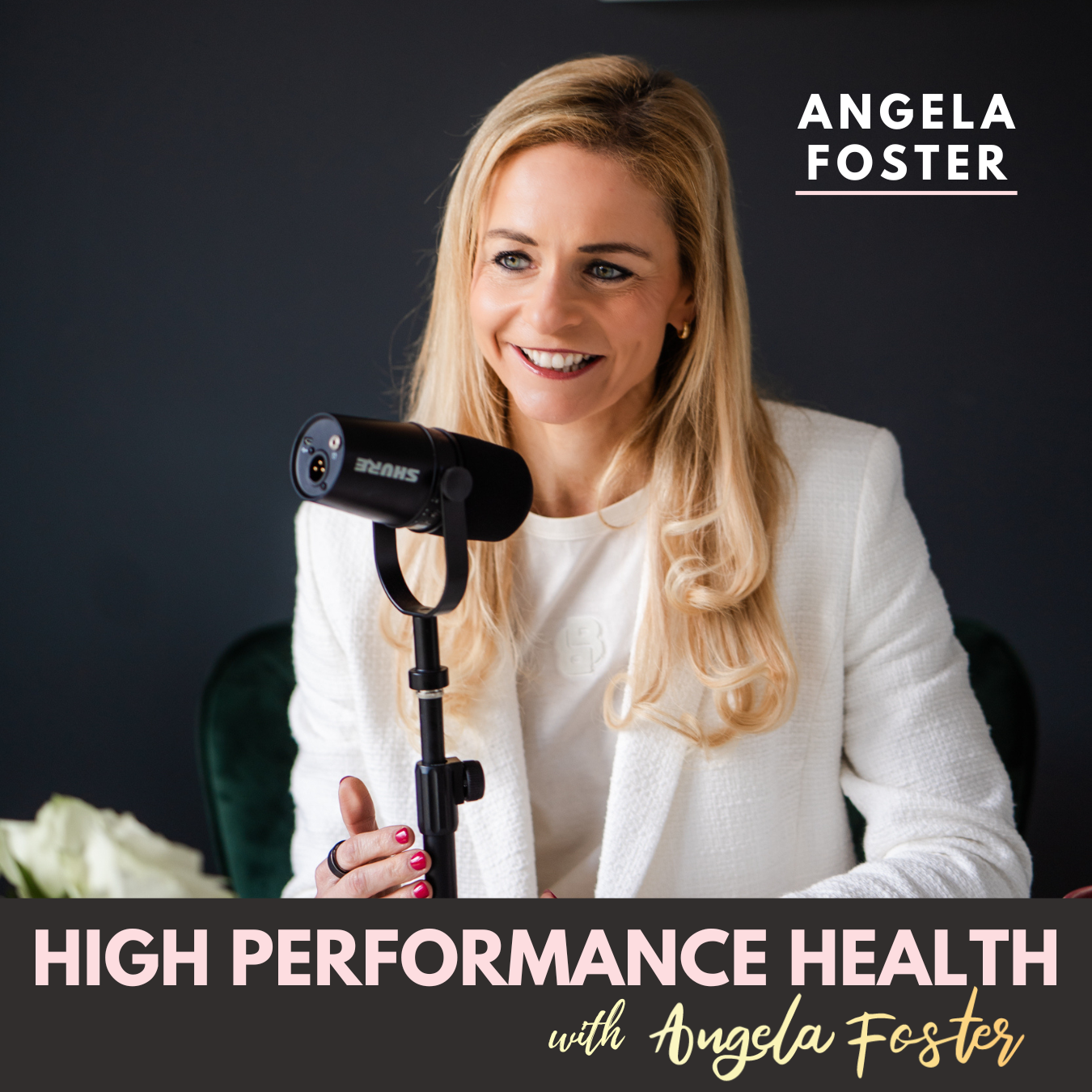
Angela Foster is an award winning Nutritionist, Health & Performance Coach, Keynote Speaker and Host of The High Performance Health Podcast.
A former corporate lawyer turned industry leader in biohacking and health optimisation for women, Angela regularly gives keynotes to large fitness, health and wellness events including the Health Optimisation summit, The Biohacker summit, Dragonfly live, Elevate Fitness conference and Gaia TV. She also delivers Health Optimisation and Performance Workshops to large multinational corporations and senior leaders with a strong focus on women’s health and burnout prevention.
Angela is also the creator of BioSyncing® a blueprint for high performing women who want to ditch burnout, harmonise their hormones and elevate their life.