High Performance Health Podcasts
The New Science of Healthy Aging: The Longevity Tests You Actually Need
Olympic medalist turned health-tech founder Andrew Steele says the problem isn't you: it's that "normal" and "optimal" are two different things. In this episode, he breaks down how DNA, microbiome, and blood testing expose what's really behind your fatigue, brain fog, and bloating. And why one test, one time, will never tell you the full story.
AUDIO
TRANSCRIPT
[Andrew Steele] (0:00 - 0:15)
The idea of normal health is a broken benchmark. People consider normal to mean like, hey, I don't quite feel right, I'm declining over time, I'm stressed, I'm just sort of malfunctioning, but I'm within normal range whenever I have a health assessment. You don't believe that normal should be normal.
[Angela Foster] (0:15 - 0:22)
One of the things that you test for that's become really popular is DNA methylation. Can you explain a bit about that and the importance of it?
[Andrew Steele] (0:22 - 0:41)
Do your genetic variants predispose you to being quite good at transforming the nutrients in the form that you're taking them through a supplement into the form that your body needs to perform its internal processes? Or have you gotten some impairment there? If they're not taking the right form of that supplement, they're not only not getting the benefit, but they're actually potentially causing a negative effect.
[Angela Foster] (0:42 - 0:48)
When we look at ageing and longevity, what are the things that we really have the most control over?
[Andrew Steele] (0:48 - 0:49)
Here's the three things you need to fix.
[Angela Foster] (0:50 - 1:19)
Andrew, it's so great to have you here today because I, for one, am just really excited by everything you're doing at Stride and what's evolving there in terms of really giving people the power back to truly take care of their longevity. I've been doing some testing myself in terms of the DNA, my microbiome, and my blood work, and it's just been really, really insightful. When we look at ageing and longevity, what are the things that we really have the most control over and what should we be looking at?
[Andrew Steele] (1:20 - 2:57)
Our day-to-day choices, I think the small things, right? We often tend to maybe zoom out and look at the big picture and say, in the societies that live to 100 years old, what are the things they're doing? But actually, the takeaways from those are normally these very small but cumulative things.
It can seem insignificant to say, I'm going to add a bunch of seeds onto this dish today, or I'm going to not eat this particular thing, or go for a very short walk to the local shop instead of jumping in the car, but that stuff done cumulatively appears to be the biggest needle mover when it comes to our health. Sometimes there's a lot of joy in these seemingly insignificant, trivial things, but you have to have the ability to just embed them as normal, standardise them into your life. That's not always easy, right?
You can look for the more difficult, big move that you're going to try and do. I'm going to cut out all of this, or I'm going to completely change the way I do this. Actually, that would work really well, but the adherence to these things is the trick.
I think it's fascinating when you look at that potential butterfly effect of super small changes in your day-to-day habits, as long as you can keep them up for many years at a time. That's probably what's leading people to have vital signs that are doing really well. Their social life is really strong.
Their social connections, their familial life, and their daily activity are as strong as they get into older age, which are often harder to achieve in the long term, but much easier to achieve in the short term.
[Angela Foster] (2:58 - 4:12)
Yeah, for sure. It is those tiny changes, and I think just understanding why we need to do them. I think what's been really interesting for me is when I look at the intersection of the things that you're testing at Stride is, for example, I have a high sensitivity to carbohydrates when I look at my genetics, but that plays one small part because we also have our microbiome to think about that is influencing the way that we metabolise carbohydrates.
Then we may not find that our genes are necessarily being expressed in a certain way, but if we're testing our blood work, then we can see what our insulin sensitivity and blood glucose looks like. What I've found is that we can start to really bring this picture together and then, as you say, make a meaningful change, which could be as simple as going for a 10-minute walk after your meal if you have that particular sensitivity, and then tracking and seeing, does this make a change in my blood work when I next test? I think what would be really helpful is if we start first with genetics, we know that this isn't the whole influence of ageing.
Our genes express themselves continuously. What can we learn from testing key parts of our DNA about ourselves that are important to our health?
[Andrew Steele] (4:13 - 6:27)
I'm really interested. I've spent most of my life, my adult life, working at, I guess, the intersection between everyday lifestyle change and your static genetic blueprint or your predispositions. Historically, people thought of genetics as only being useful for identifying hereditary, serious risks around clinical disease risk, whether it was breast cancer or Alzheimer's, or as popularised in the early years of 23andMe and AncestryDNA, your ancestral heritage.
Where I came into working in health optimisation, co-founding a health tech brand, was actually looking at the subclinical health and wellness traits. The reason I did that was because my background as an Olympic athlete, I found through trial and error that the normal way for elite sprinters wasn't really the most effective for me. Later on, I found that I actually lacked a particular genetic variant which would expect every Olympic level sprinter to have.
It's a longer story, but there's a gene called ACTN3. There's a version of this gene which is extraordinarily overrepresented in elite level power athletes. I didn't have it, even though I was Olympic medallist in a power event.
By default, the way I responded to the everyday, the normal training was not average because I was not the average when it came to that cohort of people. I love that concept. I think that concept can be written in to every decision we make every day.
We read that three cups of coffee a day is healthy, but more than that is maybe not. If you're a slow metabolizer with your CYP102 gene, then even three is probably a little bit high for you when you look into the data and you split it out by genotype. I think there's something super powerful in there.
One of the big pushbacks on genomics is, well, you can't change your DNA, but you can change what you do. I really like the idea of if you're going to go on any sort of health optimisation journey, you're going to make some changes, at least be informed as to what are the building blocks you're working with? Where do you sit on that?
Not to change what you can or can't be, but rather just to inform you with a piece of static predisposition, so you can make a better personalised choice when you have that choice available to you.
[Angela Foster] (6:27 - 6:39)
When we look at what you were saying there, I'm just curious with the ACTN3 gene and your sprinting, when you found that out, did you then change the way that you trained and did you see better results?
[Andrew Steele] (6:39 - 9:41)
Yeah, I did, but it was quite late in the game for me. I learned this as I just missed out on the London 2012 team. Quick brief history.
I had my peak when I was about 23 years old in Beijing at the 2000 Olympic Games. I made the semi-final in the individual event and I finished fourth at the time in the relay. After that Olympic cycle, I had a performance review with the head coach of the federation, with my coach, with the various people involved in my journey, who funded me as well, the funding that you get as an elite athlete in the UK.
They basically said, look, you train in a really old-fashioned way. The 400 metres is a very long sprint, so you can generally train like you're a 200-metre runner who does some endurance on top, or you can train like an 800-metre runner who does a little bit of speed work on top. I don't want to bore your listeners with exact 400-metre training protocols, but you can come at it from the short and do some endurance, you can come at it from the longer end and do some sprint work.
I used to do the long to short view, basically. I was from Manchester, from the north. I used to run along the Mersey and do tonnes of mileage and come at this in an old-school, rocky training in Siberia type of way.
Ultimately, it worked quite well for me, got me to the Olympic Games. Eventually, it did actually turn into Olympic medal, which is another story for how I got upgraded from fourth to third along the way. Then I made a change to train more like everybody else at the top level, which was to be more like a sprinter, like a short sprinter, and primarily focus on my ability to accelerate and to hold that top speed and do that in an efficient manner.
Over the next four years, that change didn't work. Basically, long and short of it, it didn't work. I improved at some technical nuances of how I accelerated and got out of the blocks and got up to speed, but I actually lost my individual calling card, which is my ability to hold on to that top pace longer than everybody else.
It wasn't effective for me. I don't think it was all down to this single genetic variant, but I think that played into this larger picture of working on your weaknesses or playing to your strengths. I was an anomaly when it came to elite level sprinters into what worked for me in training compared to nine out of 10 of them.
Then I found out after that, that genetically speaking, I was an absolute anomaly as well when it came to an elite level sprinter. It made sense for me. There is a plausible pathway by which this would have a cumulative effect on me that I was not as good at synthesising fast twitch muscle fibre from short sprint activity as compared to the rest of the people in the group I'd be training with.
It was a fascinating learning. I did switch back and I did have the second best season of my career, even as I was nearing 30, actually. Maybe you can point to some turnaround in my results, but almost a little bit too late to know for sure if that would have completely changed my fortunes.
[Angela Foster] (9:41 - 10:33)
If you'd known that information earlier. It's interesting because in terms of the everyday context, should I say, like you were just saying there, caffeine tolerance makes a huge difference. Some people will see an increase in performance if they're at work and they want to improve productivity and focus.
Other people will feel anxious when they're having too much caffeine. We can understand the way we metabolise caffeine through what is very simple. It's like a 60 second mouth swab to see that.
Similarly, if we are or are not tolerant to lactose, for example, very simple thing. How we process or synthesise vitamin D is another genetic thing. We can be more focused and then look at our blood work alongside that.
One of the things that you test for that's become really popular is DNA methylation. Can you explain a bit about that and the importance of it?
[Andrew Steele] (10:33 - 13:46)
Yes. Very popular for people to use the phrase DNA methylation. Actually, to be clear, what people are interested in learning is their genetic pathways and the predisposition to having efficient or inefficient methylation cycles.
These are big words, which you wouldn't have thought would have hit the public consciousness in health a few years ago. Effectively, what we're looking at is, do your genetic variants predispose you to being quite good at transforming the nutrients in the form that you're taking them through a supplement into the form that your body needs to perform its internal processes? Or have you gotten some impairment there?
Are you predisposed to have less of an easy time in transforming them into the bioavailable form that your body needs once you've taken in a B-group supplement, for example? People have heard about, it's been very popularised, the MCHFR genes, the MT. A selection of genetic variants have been popularised.
They're quite widespread. The mutations here, which may make people impaired in these cycles, are quite common. They're estimates between somewhere between 30% and 50% of people, depending on the cohort and the population, will have an impairment in one or more of these methylation cycles.
How does that manifest? That manifests in people if they think, I feel tired, and I've heard B12 is good for tiredness, or I've got brain fog, and I've heard this particular nutrient is good for brain fog, so they take more supplement. If they're not taking the right form of that supplement, they're not only not getting the benefit if they've got these genetic mutations, but they're actually potentially causing a negative effect because they've got this unmetabolized folic acid or a blocked pathway in one of those factors.
People are really interested to learn this. There are a lot of other environmental factors which may play into this that people are worried about, whether it's the way that crops are farmed, and there's fortification of those with nutrients, and what form and chemical form of those nutrients being applied. People are really keen to learn this.
What we find is we get a lot of new customer interest where they want to learn their methylation pathways. They want to learn if they've got the MTHFR variants, or they want to learn do they need to take methylated folate as opposed to standard folic acid. Then once they come in, they realise, hold on a second, I'm lactose intolerant genetically.
I didn't realise that. Wow, that's really made a change because suddenly my gut feels more healthy, or they figure out that actually they've got super low incidence of a certain species of bacteria in their gut because we do these other types of tests. They can unlock a number of these health optimisation layers, even though they came looking for one thing.
I do think it's an impactful marker. It's an impactful set of markers. I don't think it's the whole picture.
I would like people to have a more open mind as to think the problems they're experiencing or the optimisations they want to get from their life can come from a number of these different insights as opposed to just your methylation cycle.
[Angela Foster] (13:47 - 15:03)
Which is why you're integrating the blood work alongside microbiome health. Increasingly, I know you're going to be adding in some new tests to give people a stronger and stronger picture. One of the things I think with blood work, for example, is often people don't even see what their blood work says.
They just say, they're not feeling great. They go to their GP. Certainly here in the UK, the GP runs a bunch of tests.
You never see the ranges that are there. They're not necessarily optimal either. They're what's common.
Then you get told everything's fine. Even if you're on a borderline of something, quite often you'll just be told everything's fine. The patient's left wondering, why don't I feel right then?
They don't really have much information. If they do then go and get a form of retail test, it can be difficult to interpret and understand what that means. One of the things that I've noticed with Stride is that you're using a biological age test that was developed by Dr. Morgan Levine, where you look at key blood biomarkers that allow people to understand how their lab work or how their body, their biochemistry is influencing the ageing process. That's also something that's interesting, I think, for a lot of people. They can actually track that rate of ageing with people becoming more and more interested in longevity. Can you share how that works?
[Andrew Steele] (15:04 - 17:18)
Yeah, so I think there's a few points you touched on there. I think just to zoom out before we go into the biological age assessment is what I'm trying to build with Stride and what we're moving towards is right now, I think the idea of normal health is a broken benchmark. People consider normal to mean like, I don't quite feel right.
I'm declining over time. I'm stressed. I'm just sort of about functioning, but I'm within normal range whenever I have a health assessment and someone says, there's nothing to see here, right?
But you know, internally, you could feel better. So we're basically trying to break this idea of like, we don't believe that normal should be normal in the current sense of how we look at this. So we're trying to turn normal into optimal and that means a few things.
We also use these nine blood biomarkers for what we call the PhenoAge algorithm, which is what I think is really the best algorithm out there currently to look at the difference between how your biological age, which we phrase, which is effectively we're saying, how are you ageing, right? Internally on a cellular basis, how are you performing and how are you going to live from a health span perspective, from a lifespan perspective compared to the average? And we use that basically to say to people, look, you are, let's say in my case, I'm 41 years old and you have maybe got some improvements to make because your biological age is 47, for example, you're ageing a little bit quicker than time is passing.
And what you want to do is make sure that the changes you make, the lifestyle changes you make actually have an effect on that. So we hook a lot of the change that you could make on how can we move the needle for this biological age over time. And that's really the idea, but there's a lot of different biological age assessments out there.
It's quite confusing to look at the market and say, which one should I trust? My Whoop tells me one thing, my OuraRing tells me another, my single test that I've done on this other type of sample type, for example, could tell you another thing. So we're trying to sort of consolidate this and build the most predictable and reliable way of monitoring your own health over time by taking in as much data as possible.
[Angela Foster] (17:19 - 17:41)
And with blood, because I know a lot of the concerns people have had with consumer tests is that you could do two tests. You and I were talking about this previously within an hour of each other and they would look quite different. With blood, if you take your blood, it's pretty consistent in terms of what you're seeing.
Is that the idea of starting with blood first in terms of predicting the rate of ageing?
[Andrew Steele] (17:41 - 19:57)
Yes. I mean, there's lots of technologies that have come around by people measuring telomere length or epigenetics as a way to look at biological age. You can even get a biological age and there's a reasonable algorithm out there based off your static genetics, you know, the genotype you were born with and how that affects it.
But we liked the phenyl age algorithm from bloods the best when we did the assessment. As you mentioned, in certain tests, let's say an epigenetic test, one of the challenges has been you could take a sample now and a sample in an hour. And then we sent those off to the lab separately, you could get a different result.
So there's a lot of work to do in sort of standardising this. I think you share some experience with any lab tests, right? If you have just done a bunch of really hard exercise or you've been unwell, you can of course change the markers.
You can tip a marker one way or another, it can affect things. The good thing about the phenyl age algorithm, in my opinion, is it uses a relatively small amount of pretty mainstream biomarkers. But they did do some great research and looked into this and built this sort of range of where this is going.
Some of them are not that common. I think you'd identify it yourself, actually, there's a couple of markers there which you don't really find in the everyday blood test. But they are not some sort of black box of unknown science, which we don't know is affected by lifestyle in X manner or by doing a certain thing beforehand.
So at least they're kind of quite standardised. I do think there's more to go and I think there's a lot more improvement. In fact, we just recently were awarded a grant to build out hopefully the gold standard of a multi-omic biological age assessment.
I think something like this would be really important if we want consumers to actually engage in proactive preventative health habits en masse, is that you do kind of need a single metric to hang your hat on, as opposed to a confusing array of different success metrics. But yeah, super exciting the potential impact of measuring this over time. And yeah, where we've got to today, we use the fenoage algorithm.
I think that's the most reliable one out there at the moment.
[Angela Foster] (19:58 - 20:49)
And I mean, I think that's really exciting, because I think the thing is, people just, I think the trust issue is a big one, right? For people, they want to know that what they're looking at is data that, as you said, they can hang their hat on. It's meaningful, it's validated by science.
Dr Morgan Levine is behind the fenoage so that you know that if you're going to, you know, as we return to the beginning of the episode, start making those changes, that you're going to actually see a difference in the way that you're ageing and that you can reliably trust that data. One of the areas that you integrate that we haven't touched on yet is the microbiome. Now this is such an emerging area.
I think we all know from just so much content on social media that we need to be looking at diversity in our diet. What are the key things when we're looking at microbiome testing and how can it help us?
[Andrew Steele] (20:50 - 23:33)
Well, it's very popular on social media, right? It's like, gut health as it should be. And with all these different topics, like over the years I've seen this, something new comes out and everyone goes, ah, it's not there yet, it's too early.
And then it kind of gains some traction and everyone goes, it's all about this. And we've kind of reached like a phase, maybe the last two or three years ago, there was claims that everything is your gut health. And then you kind of move past that where it's like, no, it's a factor.
Of course, it's a factor. Of course, it's not everything. People did the same.
We were probably guilty of it in the very early days back in 2013 with DNA fit and sort of say, it's all in your DNA. And of course, it's a really important factor, but it's not the whole picture. Same with your blood, same with microbiomes.
And there's always a prone, like people are always prone to exaggerating or then under exaggerating the effects of something over time before you reach this middle. I think they call it the Dunning-Kruger effect. So anyway, where we have a microbiome, the testing ability, the analysis level that you do has moved on a lot in recent years.
So we do what's called shotgun metagenomics. It's the type of sequencing of the microbiome, which goes to a deeper level. But also our understanding of like what's healthy or not, or the effect of the gut.
And people didn't realise this not long ago, that skin conditions are largely affected by your gut health, for example. You'd continue applying harder and harsher creams onto your skin, but it could be down to the bacteria in your gut. So there's lots of factors there.
And we're looking at a number of traits related to microbiome, which impact your overall health. People don't realise just how big of an impact sometimes small changes could have there. You might have a super low level of a certain bacterial species, which if you can just repopulate that by eating enough pomegranate, for example, as a very crude example, then suddenly you'll have a meaningful change.
And if you imagine you eat something, it has to pass through your gut before it's absorbed into your bloods. So if you have a blood biomarker, which is stubbornly not changing on a nutritional factor, there could be some answer by understanding something deeper in your gut, fixing that and therefore seeing that when you do eat foods with a certain vitamin content that that reflects in your blood biomarkers. So yeah, there's always caveats to everything, but I think the gut is such an important layer.
And it's so the breadth of the potential change that can be seen by making some lifestyle changes to managing your gut health are really impactful in the long run.
[Angela Foster] (23:34 - 25:26)
I mean, it's interesting because when I look at the midlife women that I work with, I would say that and we've had thousands, tens of thousands of people take our quiz now around the symptoms that they experience and how they feel. And third, I would say to waking up during the middle of the night and experiencing brain fog is abdominal kind of bloating and also abdominal weight gain, right? But bloating is a big one and just feeling that their, you know, their digestion isn't as good.
And when we look at the research around what's changing in midlife for women in particular, the estrobolone part of the microbiome that's related to oestrogen metabolism in the body is changing. This is really interesting because when I tested my own microbiome with Stride, what I found was that the bacteria that produce butyrate were a little bit low for me and that helps reduce inflammation. So for me, that was actually a really important piece of information that I could take action on.
And I'm about to retest to see, have I improved that? And you can also monitor symptoms, right? To see, is this improving?
So by improving foods that help encourage the growth of bacteria that produce more butyrate, that can actually calm that inflammation and relieve some of that bloating, for example, that women struggle with. And so I actually found it really useful. And I think often we can feel really overwhelmed, but as you say, having the ability to have a consultation with somebody that takes you through and gives you just a few simple steps that you take away, and then you can work on those and then come back, retest and work on them again, is very, very empowering because we're also changing all the time.
When we go on holiday, right, our microbiome changes again. And so it's not like a once said and done. Oh, I did a microbiome test back in, you know, 2020.
And this is why I'm still eating this way. Do you know what I mean? It changes all the time.
[Andrew Steele] (25:26 - 28:55)
Yeah. And I think this is one of the key challenges. We did some really interesting research not long ago, looking at acute microbiome changes pre and post exercise as well.
The challenge is when something can move the needle that quickly, how do you know what to do on a sort of medium term basis in terms of lifestyle change? And that's why you've got to test and retest. It seems obvious when you say it that way.
But if you just said, hey, I'm going to get a microbiome test once and look at my results and feel great or feel bad about the results, like that doesn't actually give you any benefit in the long run. But if you tested that every six months for two years and you know what's normal for you and what has changed and what's what's improving and how you feel, then, of course, you can come to the right picture. Right.
So it's it's a really interesting thing. Recently, just like I actually had to have a colonoscopy not long ago. And if I was to have done a microbiome test, you know, immediately after going through that, I would probably think, well, I've got super low diversity in my gut because of the preparation for that.
But three months later, it looked very different. Right. So you've got to have this sort of personal picture, this longitudinal picture of who you are and what's normal for you.
And it's like it can affect amazing things, you know, your skin, your mood, your brain fog. If you can just fix a few easy things in your gut, it can be really transformational to people in their everyday life. And sometimes you feel like, I don't know if you found this, sometimes I feel, you know, if you're feeling anxious or nervous and you think that's causing your gut to feel, but it can be the other way around.
You know, like your gut health can be making you feel anxious and nervous as well. So it's a really it's a fascinating world, the world of microbiome. My personal take on this is it's harder to make sense of on its own if you can see it in the bigger picture of like where you are, what your bloods are doing, what's going on in your life, how you, the advice you're being given by a professional.
And that's why we do what we do, which is we'll look at it and we'll also give you the other omics that we've tested, the blunts and the DNA, et cetera. But crucially, what we're trying to do is give you less advice, right, for you. So actually what we're trying to achieve is look at more data than anyone else has looked at for you, but then give you two or three things that will actually, you'll be able to do and you'll be able to adhere to and then we'll actually make a change.
And when you fix those, then we can move on to the next three. And this comes from working with some of the best sort of coaches in sport over my sporting career. When, you know, if you had somebody who was an amateur runner and you wanted them to be a fast runner, you could give them a list of a hundred things they had to work on, but that wouldn't help them.
They wouldn't improve. But if you gave them one thing to fix and then they fixed that, and then you can move on to the next. And that's how you've got to sort of, the phrase is to move the biggest rocks first.
So we might look at all this data, but ideally what we end up with is a consultation with an informed professional who gives you great guidance and then says, here's the three things you need to fix. You're going to add more of this. You're going to take this away and you're going to do more of this particular supplement or whatever the outcome is.
And then in six months time, let's see where we got to. And then let's move on to the next three after that. And that's where I think you can change somebody's health rather than just blinding them with another dashboard for a blood test or whatever else they've chosen to look at.
[Angela Foster] (28:55 - 30:09)
Yeah. Otherwise it's just so much information. You can't take it in.
I mean, I think that what's really interesting is you and I go back a long way. I want to say definitely 2019, maybe 2018, when we were working together in the early days of like the DNA testing, and then you added sort of more panels and now you've integrated with Stride, what you're doing now, you know, you've integrated this microbiome and blood work, those changes that you can then make. And the consultation you have is that much more meaningful because you have more data to work with, but that doesn't mean it's going to overwhelm you because as you say, you're being guided on here's the key things that have jumped out for us for you.
And if you change those, and then you can track those changes. When we're looking at this, you mentioned there that if you've done some hard exercise that can actually change the microbiome pretty quickly. Certainly we know that with endurance athletes, right?
If you have an infection, when I did my bloods the first time I had an infection, so that raised a marker CRP that isn't usually raised in me and showed that inflammation. What is the best situation for someone who wants to do the test? Should they spend a few days like sort of down regulating the exercise they're doing, just kind of calming things down ahead of that microbiome and blood work?
For DNA, it doesn't matter, right? You can just do that anytime, it doesn't change.
[Andrew Steele] (30:10 - 32:04)
Yeah, I mean, the best way to look at this, where I always put this to people when they ask this question, just if something is out of normal, let's try and test you when you're, you know, so if you're regularly exercising, there's no point in you taking days off because then that would be an abnormal read as well, you know? So like whatever your standard is, let's try and test you when you're as close to the middle of your range as possible, which is I'm not acutely unwell, I've currently got like a flu going on, I've not like just done a marathon and I'm not a runner, you know? Like whatever is your norm, the best way to do this is to test at that point and then even better is when you retest again over time, then you know that you're getting a bigger, more statistically significant sort of picture of what's normal for you.
Of course, if you've never exercised before and you've just come off a three-day water fast and you've just run a really hard exercise, likelihood is some lab tests will probably be slightly, you know, abnormal for you because what you've just done is abnormal for you. So whatever is normal for you, that's the best like route in which to test. But I also wouldn't overcomplicate it, right?
One of the biggest factors to people making a change in life in general is waiting for the perfect timing or the perfect moment, right? And yes, even with some blood markers, you know, you want the ideal world, you'd be fasted, but if you're not, that's okay, we can take that into account and as you retest over time, you can start to see if that did cause too much of anomaly or otherwise. So I was just trying to be pragmatic.
Yes, if you're acutely unwell, likelihood is you'll have some inflammatory marker, that's a marker of being unwell. But if you are not acutely unwell, then yeah, let's just try and test you in your, as close to your normal state as possible, whatever is routine for you.
[Angela Foster] (32:05 - 32:13)
Having tested now so many people, what are the kind of three key things that you see are most valuable for people when they do it?
[Andrew Steele] (32:13 - 32:52)
People are really fascinated by their ability to metabolise the B vitamin group, for example, their methylation pathways. And these are, this is a big driver of people's habits and decision making. And I think primarily because it comes down a lot to like cognitive performance, right?
Rather than something that's more aesthetic or physical, is people are feeling tired and are feeling a lack of energy. And they're looking to understand how they can improve that. So that firstly, like people understanding that and making a change away from sort of non-methylated form to these B group vitamins has been very powerful in the feedback that comes back to us.
[Angela Foster] (32:53 - 32:54)
And that's via the DNA test.
[Andrew Steele] (32:54 - 35:29)
That's right. So the DNA test will give you that. And, you know, that's a, it's not even new technology, right?
You know, we've been able to look at genotyping. I had a business doing this from 2013, right? In my previous.
But the more and more we understand about our health, this becomes super popular. And rightly so, because it's very easy to do. You do it once in your life.
It's pretty, it's relatively inexpensive for something you can spread over the cost of your life, basically. If you take this one test, you can do it. And it's also very easy to take.
It's a swab you rub on the inside of your cheek and you send back in the post, right? It's a super easy process. So that's quite impactful, right?
And it does well. The second one, I think, you know, if we talk about this cognitive performance or brain fog, tiredness or energy is in the gut. So we have this report on the microbiome gut brain axis.
And we can look at microbial activity, which is linked to your serotonin and dopamine and see how your gut might be affecting things like your mood and how clearly you're thinking and your focus. And so these are really essential pieces of your biology that I think should just be table stakes to understand. And if we know that that has some something pointing out of kilter, then we can make a really, you know, focused change on your diet.
And hopefully you feel a lot better. And then you can, you know, as we all know, if we feel better, we've got clearer thinking, we can we can do a lot with ourselves. And that helps unlock a healthy habits.
And then the last one is just on the bloods, right? So we're really used to testing our cholesterol. And we, you know, put the people, you know, get this done routinely through their nationalised, you know, National Health Service in the UK or through their employer or through their physician.
One of the markers we've not looked at so much in historically in the UK is ApoB. And this to me is almost like the more impactful marker, which is related as a kind of proxy for those cholesterol markers. But you can see it gives you a single clear number.
And we want that number to be sort of, you know, down towards under one in the way we put it. And if we can reduce that markers of the cardiovascular risk and benefits there are huge. And so like, I think there's three things, your methylation pathway, your DNA, your your sort of gut brain axis on the microbiome and this lesser tested marker, but more impactful, in our opinion, on the cardiovascular health probably would be the top three learnings, I'd say.
[Angela Foster] (35:30 - 36:17)
Yeah, 100%. And that's the thing that it's very difficult to get at the minute to get your doctor to do the ApoB certainly here in the UK. And it is super useful, as you say, you mentioned this multi-omics.
So at the moment, people are used to looking at their wearable data. I think that from what you're saying, you planning to now integrate some of that in the future, right, that's coming so that people can start to look at their DNA, their microbiome, their lab work, their wearable in terms of how well they're sleeping, their HRV, which we know is also connected to longevity, their resting heart rate. There's plans, I understand from you to start to integrate that in the coming months, so that you can start to get a complete picture alongside, you mentioned the oral microbiome, which is really interesting, and the link between that and things like cardiovascular disease.
I'd love to hear more about that.
[Andrew Steele] (36:18 - 38:57)
Yeah. Okay. So I mean, the best way to frame this is you think back to early wearables, right?
We considered a wearable device a way of doing one of two things, a step counter, and maybe a heart rate monitor, right? That was like what we considered they were for. But if you chose the right device or the right provider of that device over time, there was extra metrics that you could learn from there, right?
Your heart rate variability, your sleep tracking, strain score, et cetera, all these, all these factors. And suddenly now these are multi-billion pound businesses, and people are wearing them, not as a sort of, you know, I wore this for three months and put it in the drawer afterwards, but as a lifestyle, you know, wear and track these biometrics as a lifestyle. I believe that's table stakes for the future of sort of, you know, consumer health or population health is that yes, you're tracking this stuff.
And what we think is we need to go deeper. So we need to track your internal biology at the same time as tracking our biometric data through a wearable device. So where we're going with this is if you join Stripe right now, you'll get the, you know, the testing that we do as part of the membership, the DNA, the microbiome, the bloods, and the biological age assessment.
We recently acquired an amazing oral health test, which looks at the oral microbiome and the oral protease. People don't realise this is a great proxy for systemic health over time. Really early signals of inflammatory response.
As you can imagine, if you're worried about your gut microbiome in your colon, you probably should be thinking about the microbes that are in your mouth and swallowing every day, all day, every day, right? So there are many factors now. We know that sort of improved oral health is a very strong indicator of improved ageing health over time as well as lower risk of Alzheimer's, for example, in people that floss.
You know, there's really fascinating things in there. So we've got that and we'll be adding the oral test into the overall membership. So if you join this next time your testing milestone comes along, there might be more tests and more omics and more analyses as part of that, just as your wearable moved from step counting to heart rate, to heart rate variability, to sleep tracking, et cetera, over time.
And that's what I want to do. I want to create this lifestyle, this choice to track your biology, even if it requires a lab test, repeatedly over time. And we're also going to be integrating the wearables.
So you can link your wearables, link your Apple Health app, link wherever you are, meeting users where they are, the tools they use. So we can take them into account when we see all your lab data too and hopefully give you the best advice possible, basically. That's what it all comes down to.
[Angela Foster] (38:57 - 39:26)
I love the vision of just like integrating, having all of that in one place where you can really kind of measure and then track what you're doing and to see those results in real time. Let's talk about, for our listeners who want to try this, I know you've got a special discount that they can use. What's available in what country and what's coming?
So in the UK, you can get the full works in terms of microbiome, DNA and blood work. What if you're based elsewhere in Europe or in North America or Australia, New Zealand?
[Andrew Steele] (39:26 - 40:51)
Yeah. So in the UK, Stride1 is our sort of hero membership, which is the thing we've discussed. DNA, microbiome, bloods, repeated every six months apart from your DNA, which doesn't change, with four quarterly practitioner consults and everything else in that platform there.
So that's our hero product in the UK. Outside of the UK, we can do everything, but we haven't yet made live the ability to have your bloods because we require us, the botanists, to come to you, take a venous blood draw and integrate that. So we expect to launch this outside of the UK, starting with the US in the next three to six months.
So certainly by the end of the summer 2026, we should have the full membership available in the US, potentially Canada as well. And then before the end of the year, we'll have the full membership available, hopefully in the rest of the world too. In the meantime, outside of the UK, you can get everything else.
So the DNA test, the microbiome test, the supplements that we make and the consultations, we just don't wrap it all into one single membership. So basically you can put most of this stuff together yourself through Stride1 if you're outside of the UK. And we do do a good portion of our users outside of the UK, but we'll soon be live with the full membership in the next three to six months.
[Angela Foster] (40:51 - 40:56)
Very exciting. When do you think the oral microbiome and the epigenetics will come?
[Andrew Steele] (40:56 - 41:31)
By September, yeah. So hopefully in September we'll add in the new tests into that because we just were awarded this grant to build this sort of multi-omic product piece out further. And we've got a little bit more product work to do and a little bit more R&D work to do there, but I'm very excited about adding those into the mix.
And the beauty of it is you don't need to give us any more samples. The same amount of sample, the same sample types that we would already be taking, we're just able to extract more from the stuff that you've already provided to us.
[Angela Foster] (41:32 - 41:37)
That's really exciting. And the wearable, will that information be also integrated to come September?
[Andrew Steele] (41:37 - 41:50)
Yeah, that's actually a really easy feature. Not making our work sound too easy. Basically, that'll be a feature which people will have to turn on in their dashboard themselves as soon as we make that feature live.
[Angela Foster] (41:51 - 42:10)
And the consultations people can have, you said anywhere in the world as well, because I think that's also really interesting because so much of what we're getting now is just these dashboards of things and AI giving advice and algorithms as opposed to actually having a human on the other side who's trained and can consult with you and help you integrate those habits. That's all included.
[Andrew Steele] (42:10 - 44:51)
Yeah, so I mean, this is a key thing, right? I think even myself included in my first one or two businesses, you can fall into what I call this empowerment trap, which is where you give someone a bunch of data and then you say, by the way, you're now empowered to go and live healthily. Goodbye.
And it's kind of shorthand for saying, it's not our problem what you do with this, that you actually see this through. And I think nowadays, it's very easy to get data. What isn't easy is to know what to do or to have accountability for the end output.
So I'm really keen and really sort of we're all in on being responsible for that end state. I think the winner in our field will be the brand or the company that actually changes people's health over five years, not just wins the most customers in the first one or two years. So I'm really all in on not just being an empowerment provider that says, here's a dashboard, you're empowered.
So the key thing is giving you that advice. And I don't think you can give the best advice if you don't have some sort of human touchpoint in there. I think you can go quite far.
But the difference when you speak to a qualified practitioner who knows your results and your tests, and then you can have a conversation about what's going on in your life and what works for you. Oh, I hate riding an exercise bike. OK, we're not going to tell you to do that type of exercise, for example.
And the beauty of it is in a lot of services like us, when they have these sort of practitioners, they're often like third party individuals who are not employed by the company and are just sort of freelancers doing some spare hours in their lunch break, for example. And that means that they can't have access to all of your data. We bring this fully in-house.
So they're employed by us, they're in-house. And it means that the call notes from those transcriptions can go into your product. And it can shape the advice we give you, as opposed to just being a one-off, non-integrated human service that you can make available.
So I think any business now that wants to actually affect somebody's health, I think they're missing a trick if they don't have a human as part of that loop. And we can do that quite scalably. So it's a big transformation for our users.
You can get some good value from a dashboard, of course you can, but you have to be really passionate about it to put that into action. When you speak to a qualified professional about your results and about the action you're going to take, and that action is reflected in your online experience, then you can see how you can actually make a long-term change in your lifestyle.
[Angela Foster] (44:52 - 45:40)
Yeah, 100%. Because as you say, they can understand your life and help you actually implement it. That's what I find.
I think the coaching, yeah, that's where I always see the best results with my own clients is actually helping them put the practical measures in place. So where can people go? I think we have a discount code.
If they go to getstride.com forward slash Angela, that will give them 10% off. If you're in the UK, that you can get the Stride One full membership. At the moment, up until September, you can get the microbiome and DNA test, but those are a great place to start.
Even the DNA and understanding those pathways and methylation alongside the microbiome has just been super insightful for me. So we will link to that in the description. Is there anything, Andrew, that we haven't covered here?
I just, I love the vision going forward. I just think it's pretty amazing. Is there anything we haven't touched on that you want us to share before we close?
[Andrew Steele] (45:41 - 46:17)
What I will say to anyone is like, we've got a whole, you know, array of products, right? From the DNA test to the microbiome test, the blood test, the membership, the supplements, every single one of them can later be, you know, added to. So if you come in and you just want to learn your methylation pathways, no problem.
And later on, you feel like you want to add in the microbiome or you want to upgrade to the membership. That's all possible from within the platform too. So it's about just meeting people where they are, how they want to start, what they want to learn, give them the best support possible.
And then as they grow and that health journey grows with them, then the products we've got available to take the next step are always there.
[Angela Foster] (46:17 - 46:33)
Oh, that's great to know. So you can kind of start with something and then build up from there because you've got that data on the platform, then it becomes additive as you add more, right? And it just, you help to refine that advice.
Thank you, Andrew, for everything you're doing and for coming on the show today and sharing all of this. I for one, I'm very excited about it.
[Andrew Steele] (46:33 - 46:35)
Great. Thanks for having me, Angela. Great to be here.
DESCRIPTION
Olympic medalist turned health-tech founder Andrew Steele says the problem isn't you: it's that "normal" and "optimal" are two different things. In this episode, he breaks down how DNA, microbiome, and blood testing expose what's really behind your fatigue, brain fog, and bloating. And why one test, one time, will never tell you the full story.
WHAT YOU'LL LEARN
- Why small, consistent daily habits move the needle on longevity more than big lifestyle overhauls
- How the ACTN3 gene explains why "average" training and health advice doesn't work for everyone
- What DNA methylation is, and why taking more B vitamins can backfire if you have an MTHFR variant
- Why "normal" bloodwork isn't the same as optimal health
- How the PhenoAge biological age test measures how fast you're really aging
- Why bloating and brain fog in midlife women are often linked to the estrobolome and gut bacteria
- Why microbiome and blood testing needs to be repeated over time, not done once
- The best way to prepare for accurate blood and microbiome test results
- The three biomarkers Andrew recommends testing first: methylation, gut-brain axis, and ApoB
- Why wearables alone can't give you the full picture of your health
- How Stride is integrating oral microbiome testing and wearable data
- Why data and dashboards alone don't change behavior without human coaching
- What's inside Stride's ST01 liposomal multivitamin and why it's formulated around methylation
VIDEO
TIMESTAMPS
00:00 Small Daily Habits, Genetics And The ACTN3 Gene Story
09:35 DNA Methylation, MTHFR And Why More B Vitamins Isn't Always The Fix
13:15 Why "Normal" Bloodwork Isn't Optimal, And The Biological Age Test
20:45 The Gut-Hormone Link In Midlife Women, And Why You Need To Retest
31:00 How To Get Accurate Results, And The 3 Biomarkers Worth Testing
36:45 The Future Of Health Tracking: Wearables, Oral Microbiome And Multiomics
40:30 Stride Membership Availability And Discount Code
43:45 Why Data Alone Won't Change Your Health Without Human Coaching
46:30 Inside Stride's ST01 Supplement, And Final Thoughts On Aging Well
VALUABLE RESOURCES
A BIG thank you to our sponsor who make the show possible:
• Stride - Find out your biological age and how your daily habits are influencing it with DNA, bloodwork and microbiome testing with a Stride One membership
https://www.getstride.com/angela/ for 10% off
- Follow Andrew on Instagram: https://www.instagram.com/andrewsteele/
Click here for discounts on all the products I personally use and recommend
Want to go deeper? Start here:
💌 Fresh Start Sunday Newsletter
Your weekly 3-minute guide to creating the healthiest, most vibrant version of you.
Each Sunday, get one simple habit to boost energy, balance hormones, and enhance longevity - joined by 25,000+ women worldwide.
👉 https://angelafosterperformance.com/
🥗The Ultimate Guide to Creatine for Women -
👉 https://academy.angelafosterperformance.com/creatine-guide
⚡️ 10 Habits that Helped me reverse my Biological Age by 25 years in Perimenopause -
👉 https://academy.angelafosterperformance.com/10-habits-optin-page
Disclaimer: The High Performance Health Podcast is for general information purposes only and do not constitute the practice of professional or coaching advice and no client relationship is formed. The use of information on this podcast, or materials linked from this podcast is at the user's own risk. The content of this podcast is not intended to be a substitute for medical or other professional advice, diagnosis, or treatment. Users should seek the assistance of their medical doctor or other health care professional for before taking any steps to implement any of the items discussed in this podcast.
Recent Episodes

The Hidden Cause of Weight Gain, Fatigue & Brain Fog in Women Over 40 | Dr. Amie Hornaman
How to Get a Flat Stomach at 50 (7 changes that worked) | Angela Foster
The New Science of Healthy Aging: 5 Biomarkers That Predict How Well You'll Age | Florence Comite

Five Diet Changes to Lower High Cholesterol in Perimenopause
About Angela
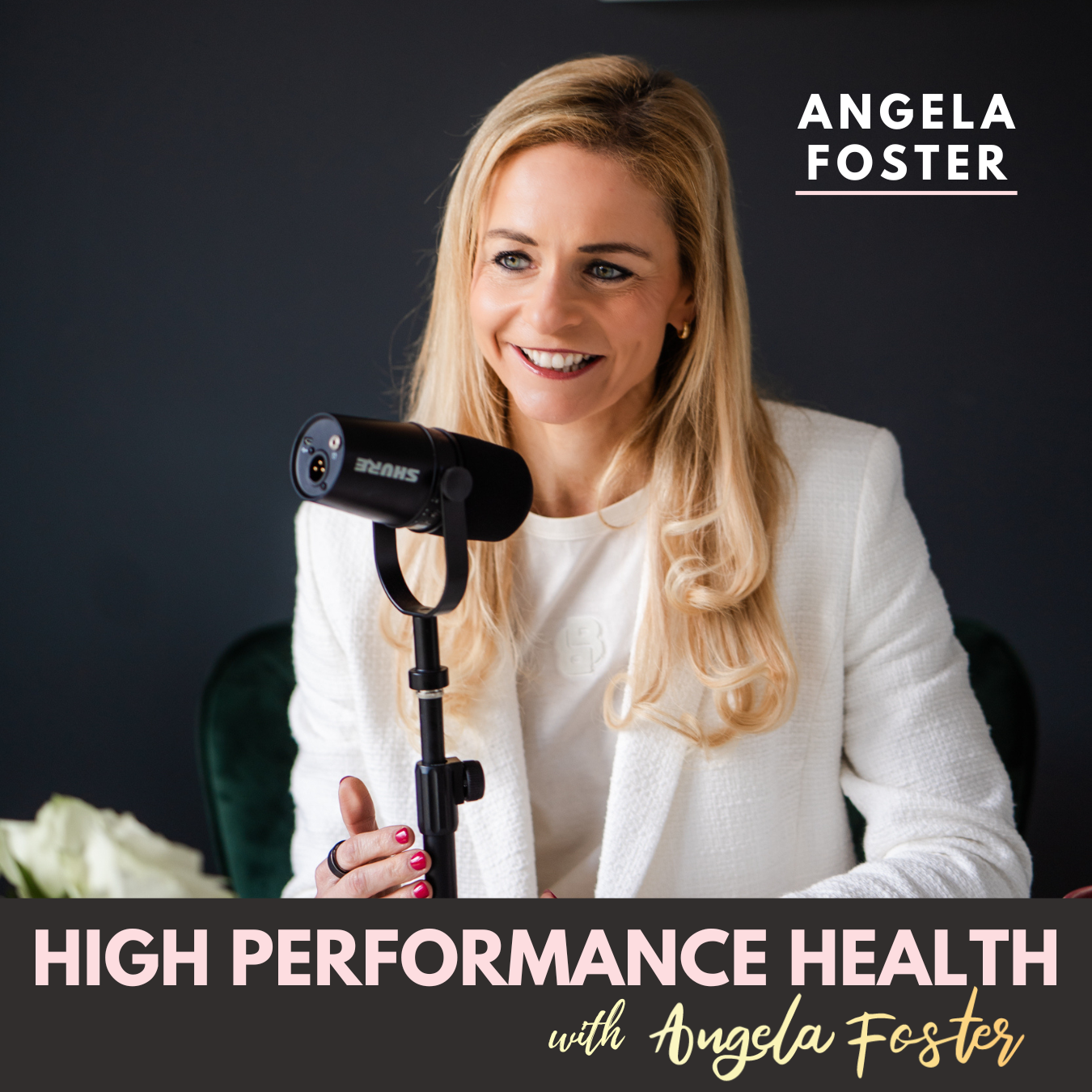
Angela Foster is an award winning Nutritionist, Health & Performance Coach, Keynote Speaker and Host of The High Performance Health Podcast.
A former corporate lawyer turned industry leader in biohacking and health optimisation for women, Angela regularly gives keynotes to large fitness, health and wellness events including the Health Optimisation summit, The Biohacker summit, Dragonfly live, Elevate Fitness conference and Gaia TV. She also delivers Health Optimisation and Performance Workshops to large multinational corporations and senior leaders with a strong focus on women’s health and burnout prevention.
Angela is also the creator of BioSyncing® a blueprint for high performing women who want to ditch burnout, harmonise their hormones and elevate their life.